


On July 17, CBS announced the cancellation of The Late Show with Stephen Colbert. One week later, the Federal Communications Commission approved the $8.4 billion purchase of Paramount Global [the CBS parent company] by Skydance.
Many see a correlation between the upcoming exit of one of Donald Trump’s most stinging critics and the Trump FCC attack dog’s signing off on the sale.
Colbert had been critical of CBS’s decision to give Trump $16 million to settle a lawsuit which caused our orange snowflake “mental anguish,” a lawsuit which Paramount had earlier called “completely without merit.” Calling the payoff “a big fat bribe,” probably did not endear Colbert to the muckety-mucks above him, especially since Skydance is owned by pro-Trump billionaire Larry Ellison.
So, Colbert got shown the door [in 10 months, if he lasts that long], and Skydance got its new holdings. And Variety reported that Trump claimed Skydance has promised him another $20 million in advertising spots for Trump-approved causes.
Nothing is as effective as using the power of the federal government to line the pockets of our grifter-in-chief. [A Scottish golf course promotional tour at taxpayers’ expense?]
Many think that the “financial decision” revolved “purely” around the finances in Skydance’s purchase of Paramount Global.
Unfortunately, media organizations prioritizing profits over product is nothing new. The Supreme Court declared corporations have the same rights as people. Corporations, too must be fed.
During my brief stints as an unblacklisted newsman, I saw a newspaper group loudly and proudly become a publicly-traded corporation. The immediate effect was that anything that might adversely affect the quarterly bottom line was frowned upon. Satisfying shareholders and the market overruled journalistic needs. Profit over product.
Twenty years later – by which time the Mighty Bean Accounters had eliminated many “expense centers” at the core of the operations – reporting finances to corporate controllers was a daily requirement as the need to “grow” profit margins kept increasing.
Today, many large cities with once proud and influential newspapers have no local news source. It was not the Internet that killed the messengers.
Thus, when Dr. Patrick Soon-Shiong, owner of the Los Angeles Times, announced last month that it would be “forming a new company that will offer financial shares of the newspaper to the public,” the $75 million it hopes to raise will come with ever-tightening strings attached.
When Jeff Bezos bought the Washington Post in 2013, the paper reported optimistically:
“Bezos, 49, will take the company private, meaning he will not have to report quarterly earnings to shareholders or be subjected to investors’ demands for ever-rising profits, as the publicly traded Washington Post Co. is obligated to do now. As such, he will be able to experiment with the paper without the pressure of showing an immediate return on any investment.”
Let’s give Bezos the benefit of the doubt and say that he, too, saw himself as a worthy champion to uphold the Graham family’s hard-earned reputation of excellence.
But Bezos also owns Amazon, the aerospace company Blue Origin, and, through Amazon, Metro-Goldwyn-Mayer, Whole Foods and more than 100 other companies, according to Thomasnet.com.
Instead of shareholders to satisfy, Bezos has companies to protect. And the biggest predator roaming America today is a president committed to punishing any perceived enemies.
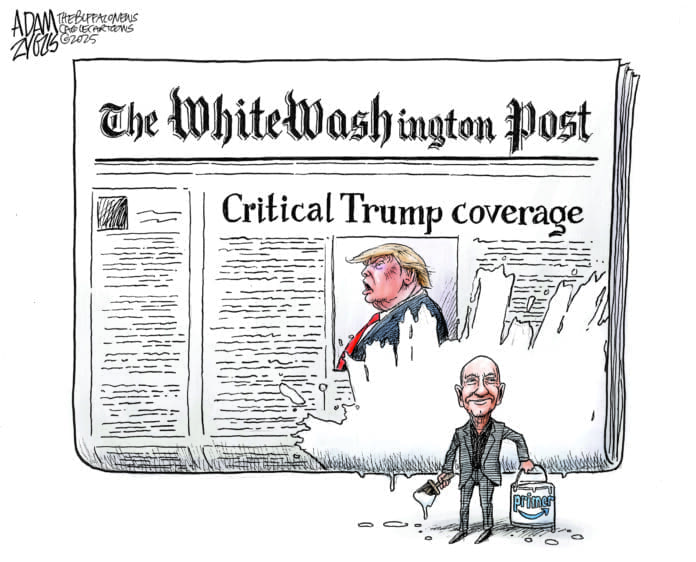
A first hint of the loss of The Post’s historical independence came last fall when Bezos killed the paper’s proposed endorsement of Kamala Harris for president. His presence as one of the Four Oligarchs of the Apocalypse at Trump’s inauguration augured more restrictions to come for writers and columnists.
In between time, in January, more than 100 Washington Post staffers were fired.
Many remaining ink-stained wretches, comfortable with their old freedom and chafing with being muted, found themselves as those anathemas of the corporate world – not team players. Many have left under duress.
In July, Justin Baragona of the Independent observed:
“The flood of high-profile editorial talent fleeing the Washington Post as the storied newspaper revamps its opinion section to focus exclusively on ‘personal liberties and free markets’ continued to grow this week as Pulitzer Prize-winning columnist Jonathan Capehart decided to take a buyout.
“Capehart’s departure comes just days after longtime Post reporter and writer Philip Bump announced that he had also accepted a buyout and had written his last column, which followed the paper’s beleaguered CEO Will Lewis’ ultimatum to staffers to leave if they ‘do not feel aligned’ with the company’s new direction.”
Other departees Baragona noted include: Pulitzer Prize winning columnist Eugene Robinson; cartoonist Ann Telnaes, who won a Pulitzer after leaving; Joe Davidson, who helmed the Federal Insider column for the past 17 years, and Ruth Marcus, employed since 1984, who also had a column killed.
Heck, Glenn Kessler, WaPo’s fact checker for the past 15 years, left “the best job in journalism.” Fact-checking Trump’s lies is a full-time assignment that evidently is no longer a priority.
Bezos’s killing of the Harris endorsement and other signs of his cozying up to Trump, Baragona wrote, “resulted in the loss of hundreds of thousands of subscribers and the resignations of several editorial board members.”
The ongoing exodus of staffers led the Poynter Institute to wonder last month: “How much longer can the Washington Post bleed talent?”
But talent cannot be monetized to be as valuable as possible, costly restrictions upon a corporation’s octopus-like appendages. Corporations must be fed. Profit over product. Capital makes cowards of the corporate media.