


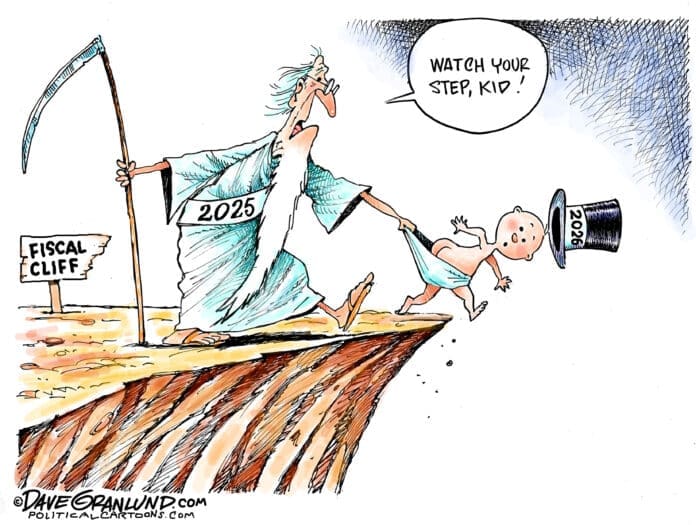
Oklahomans received bad news last week, the real life equivalent of a lump of coal in their Christmas stockings.
The State Board of Equalization – which helps determine how much legislators can spend each fiscal year – estimates $692 million less will be available in 2026-27 to help cover vital state services.
That may not sound calamitous, given Oklahoma’s current budget weighed in at $12.5 billion-plus and nearly $1.8 billion is parked in the state’s Rainy Day and Revenue Stabilization Funds.
But storm clouds are quickly gathering. An already lean state budget is about the get leaner.
State revenues are slowing. Oil prices are lagging. The economy is in tumult. And state leaders – led by Gov. Kevin Stitt – are hell-bent on cutting taxes.
The governor and Legislature already have set in motion a plan aimed at eliminating the state income tax, the fairest tax of all because it is based on ability to pay. Some lawmakers want to abolish property taxes, too, which fund schools, CareerTech, cities, counties, health departments, and libraries.
We’ve seen this movie before – a dystopian tale that previously led the masses to descend on the Capitol and turn up the heat on legislators, forcing them to generate the revenue necessary to fund vital services.
It’s a byproduct of term limits. The forced, periodic turnover was sold as a good thing: Fresh faces, new ways of thinking, fewer entrenched leaders beholden to special interests.
It hasn’t worked out that way, of course. When legislators come and go, institutional memory is lost. A steady stream of newly-electeds don’t know where committees meet and restrooms are, much less what’s involved in public policy sausage-making.
Few decision-makers remain from 2018, for example, when teachers walked out of classrooms and marched on NE 23rdand Lincoln Blvd., leading to the only tax hike since voters embraced SQ 640’s anti-tax restrictions in 1992.
Meanwhile, special interests never go away. They now are more powerful than ever because they are the ones providing institutional memory … shaping the information in ways that advance their public policy priorities.
It is elementary, but bears repeating: Schools, roads, bridges, prisons, mental health facilities, first responders and other public services don’t magically appear.
They are funded via t-a-x-e-s. Our shared community investment.
Unfortunately, keeping state and local public services afloat is even more complicated these days given the tumult in Washington, where it’s unclear what will be cut – and by how much – under the Republican-controlled Congress and White House.
That makes Oklahoma budget-writing especially tricky given we annually receive far more in federal funding than we send to D.C. in taxes – $20 billion more in FY 2024, according to USAFacts.
As OKPolicy Fiscal Analyst Aanahita Ervin put it, “We are at a fork in the road. While there is always an amount of uncertainty every year during budget planning, fiscal uncertainty is far more salient this budget cycle.”
Though recurring state revenue is up about $338 million in the current fiscal year, state agencies already have requested $1.65 billion more to meet next year’s demands.
Why? Inflation, for one. Plus, Oklahoma’s population is increasing. And the feds slashed funding for such things as food and healthcare assistance – shifting the burden to states.
Nonetheless, Stitt insists he’s “very, very pleased” with the state’s financial picture heading into the 2026 session, suggesting critics warning of tax cut consequences are simply “sky is falling” Chicken Littles.
Easy for him to say. He’s term-limited, entering his final year as governor. He won’t be on the hook if – when? – the you-know-what hits the fan. Which Oklahoma history tells us it all-too-often does.