


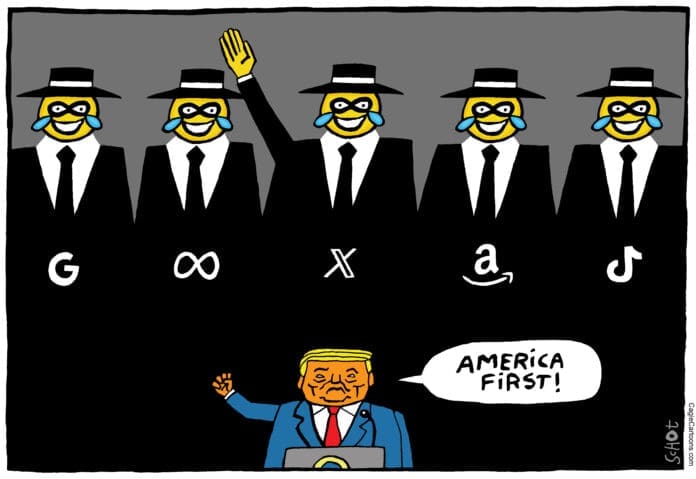
Feudalism flourished in the medieval ages as a hierarchical class structure in which serfs served their lords, who in turn served their king. Today we see something rather similar, crossed, however, with growing corporate interests.
On Jan. 20, Donald Trump’s second presidential inauguration was decorated with tech billionaires, with the likes of Sundar Pichai [net worth $1.6 billion], Tim Cook [$2.6 billion], Mark Zuckerberg [$222.5 billion], Jeff Bezos [$252 billion], and Elon Musk [$713.2 billion, a notable one-year uptick from just $436 billion on the beginning of 2025] sitting not just among the crowd, but in the front row, even ahead of Trump’s own cabinet.
Now more than ever, these tech entrepreneurs exercise power with their wealth – and it has never been easier to do so.
Trump coin, a crypto currency that launched just before the second inauguration, has helped Trump’s net worth skyrocket from $3.9 billion in late 2024 to $7.3 billion dollars now. This coin can be traded privately through decentralized crypto exchanges[DEX], and some investors have poured hundreds of millions of dollars into the coin, leading to private dinners with the president himself.
Corporate and private interest has never centered as precisely on the U.S. president as it does now. And as the Trump agenda merges with the private-tech agenda, the United States will see a shift into a new age of techno-feudalism.
Yanis Varoufakis, former Greek Finance minister, published a book in 2023 titled Technofeudalism: What Killed Capitalism. The premise is simple: the lands the lords once controlled are now cyberspace, and the farming their slaves did for food is now the farming you do for clicks and data. The lords continue to make their money, while you are drained of all you have.
In this new digital age, you are, however, offered a choice in the matters. Stay online and caught up with the world, selling your digital soul, or stay out of the world’s matters entirely, risking ostracization.
Some of the aforementioned men own the companies with which you stay active in your daily digital life: Tim Cook is the CEO of Apple; Sundar Pichai is the CEO of Alphabet, parent company of Google; Mark Zuckerberg, CEO of Meta which includes Facebook and Instagram. Even Elon Musk, the richest man in the world, owner of many companies and CEO of X, formerly Twitter, was the singular head of the unofficial Department of Government Efficiency [DOGE] after Vivek Ramaswamy stepped down and before relations with Trump turned sour.
As the names of these digital oligarchs become synonymous with that of the robber barons of the First Gilded Age, as a nation we also transform into something else entirely: our corporate-aligned interests are so thinly veiled that even in our recent invasion of Venezuela, it was abundantly clear that this was a joint venture between the Executive Branch and oil-based corporations – a scheme nought more than a cash grab.
The profound conflict of interests is astounding – not only do these men sit comfortably at the top of the world’s economy as lords of our digital era, but also they now have ties with perhaps the most powerful man in the world: Donald Trump.
And these are not the only billionaires nestled comfortably at Trump’s side. The list of the rich Trump cohorts seems to be never ending, and those that control our nation with their dollars are closer to the top than they may seem.
Whether they sway entire elections with their massive wealth, plunder natural resources from other countries under the direction of our president, or pay our president with what is essentially direct deposit through Trump Coin, wealthy individuals and corporations alike have become a key component of the New Trump Administration, and possibly a new America.