


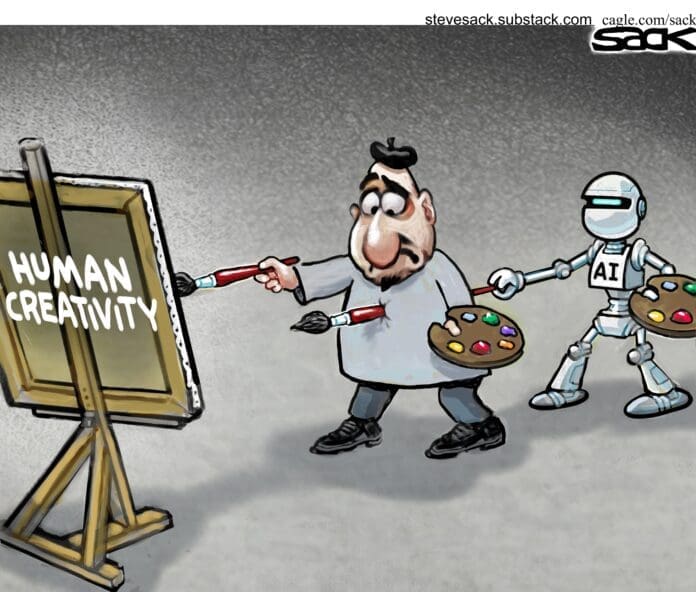
On May 19, during an interview with Joe Rogan, billionaire software engineer and venture capitalist Marc Andreessen bragged aloud about what many of his contemporaries see as the future American workforce – no workers.
Extolling the “efficiency” [always a trigger word for management] of artificial intelligence, Andreessen noted how AI eliminates tiresome personal interactions in the workplace. He elaborated:
“By the way, [AI] never gets drunk, never gets sick, never gets high.”
“Never gets depressed because his girlfriend broke up with him,” Rogan interjected.
“Never files HR complaints,” Andreessen continued.
That same day Business Insider reported, “More than 30 companies have laid off employees so far in 2026, continuing the trend of significant workforce reductions across a broad range of industries, including tech, media, finance, and retail.”
Business Insider cited “a World Economic Forum survey last year [that] found that some 41% of companies worldwide expected to reduce their workforces in the next five years because of the rise of artificial intelligence.”
Among the companies Business Insider listed as firing employees four months into this year are:
- Angi, formerly Angi’s List, 350 jobs “in light of AI-driven efficiency improvements.”
- Atlassian, a software company, “cutting about 10% of its workforce as it invests in AI to reshape its organization.”
- Coinbase, 14% of its staff. “I’ve watched engineers use AI to ship in days what used to take a team weeks,” CEO Brian Armstrong said.
- Crypto, 12% of its employees, CEO Kris Marszalek saying the cuts target “roles that do not adapt in our new world.”
- Freshworks, 11% of its 4,500 workers, increasing AI usage “to streamline the company’s organizational efforts and product development process.”
- Nike, “roughly 1,400 jobs mostly from tech.”
- Wisetech, “cutting 2,000 jobs, or 30% of its staff, citing AI-drive efficiency gains.”
Pinterest announced cutting “less than 15% of its workforce as it makes “organizational changes to further deliver on our AI-forward strategy.” Its spokesman offered the sop of “we’ve made the difficult decision to say goodbye to some of our team members. We are grateful for their service and supporting them with separation packages and benefits.”
A pat on the back instead of a kick in the backside does not soften the blow on the way out the door.
It is more humane – and more human – than what CEO Bill Winters told Reuters when his Standard Chartered bank of London announced 15% in job cuts: “It is not cost-cutting, but it is replacing, in some cases, lower-value human capital with the financial capital and the investment capital that we are putting in.”
Yeah. Yay! Eliminate that “lower-value human capital.” Tell us how you really feel.
Business Insider reported that “Meta began laying off employees across multiple teams on March 25, including Reality Labs, Facebook, recruiting, sales, and global operations” as it “ramps up spending on AI infrastructure and talent, … spending hundreds of billions of dollars on beefing up its AI capabilities.”
Julia Conley of Common Dreams was reporting on May 20 how many Meta employees had, the previous day, protested Meta’s AI data tracking program which they saw as taking the expertise to make them expendable.
Zuckerberg had inferred that during an April company-wide staff meeting, the audio of which was subsequently leaked to the media:
“The average intelligence of the people who are at this company is significantly higher than the average set of people that you can get to do tasks. So if we’re trying to teach the models coding, for example, then having people internally build tools or solve tasks that help teach the model how to code, we think is going to dramatically increase our model’s coding ability faster than what others in the industry have the capability to do, who don’t have thousands and thousands of extremely strong engineers at their company.”
While Zuckerberg apparently tried to shift the focus by assuring workers that the tracking program was not intended to spy on their private lives, according to Conley, employees told the New York Times that they feared “they had unknowingly been training a model that would ultimately replace them.”
I wonder how many of those “extremely strong engineers” were among the 8,000 employees recently cleaning out their desks.
The nonchalant arrogance of business leaders as they relegate dedicated employees to oblivion has sparked a backlash.
During the college graduation season, some AI-pushing commencement speakers have received less than the adulation to which they are accustomed from people desperate to stay in favor and stay employed.
Eric Schmidt, the former CEO of Google [How can I turn off that damn AI search function?] was booed lustily at the University of Arizona, according to Janus Rose of the Verge, “after praising AI and describing the technology as both inevitable and mandatory.”
Big Boss Man that he is, Schmidt countered the discontent: “When someone offers you a seat on a rocket ship, you don’t ask which seat. You just get on.”
Independent journalist Maria Kabas of The Handbasket [her logo shows flames emerging from a picnic basket] said later that is was no offer: “These young people have already been forced onto the ship and there aren’t enough seats.”
She mentioned how a few days earlier record executive Scott Borchetta, CEO of Big Machine Label Group had received a similar unwelcome at Middle Tennessee State University.
“When the students, whose job prospects have shrunken significantly because of the AI bubble, booed Borchetta, he shot back: ‘Deal with it. Like I said, it’s a tool.’”
Wait. Who’s a tool? The AI invasion of the music industry threatens true creators with the same outcomes as the Meta engineers. Only there, AI tools appropriate voices and sounds and styles instead of coding. AI music has already hit the airwaves.
Kabas expresses the sentiments of many when she says, “We’re told that if we don’t use AI then we’ll get left behind, but what if we’d like to leave the AI boosters behind instead? It’s time to give a voice to those who don’t view AI as an inevitability but a liability.”