




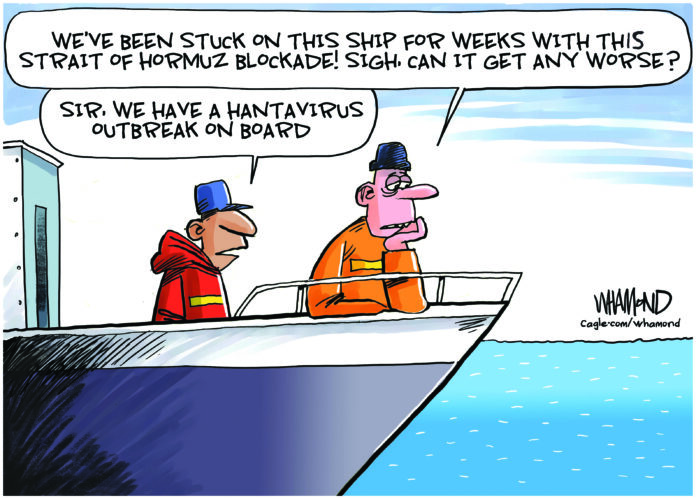
The next facet of the end-times has been the talk of the globe: hantavirus.
Many experts are saying it’s nothing to worry about, but the evident public backlash shows a lack of faith in the powers that be. And that was anticipated.
Ever since President Trump pulled us out of the World Health Organization in January 2025, alongside a flurry of other executive orders, and slashed the funding for the CDC, our confidence in handling any possible epidemic has plummeted.
And Trump’s track record is already rather poor; while the GOP maintains it was Biden’s handling of the Covid-19 pandemic that tore us apart, it actually was Trump’s abysmal management – and handoff – of the public health crisis. It took just slightly over a month after the virus first enter our country before becoming a declared national emergency on March 13, 2020.
Now the same fears are returning. I’m not much of a doomsayer and, truthfully speaking, I don’t believe hantavirus will be the same disastrous phenomena as Covid-19, but the public has been blindsided and fear is growing. As of Monday, two more Americans have tested positive for hantavirus, including one at the University of Nebraska Quarantine Center. [The second is exhibiting mild symptoms.]
But here are the facts: The cruise ship was visiting the bottom of the globe with around 150 passengers; a Dutch husband and wife picked up the disease somewhere in Argentina after the ship set sail on April 1. The husband, age 70, died of hantavirus on April 11 – just five days after showing symptoms – but at the time the cause was unknown. The body remained on board while new passengers boarded the ship. On April 24 the wife, along with more than two dozen passengers, disembarked on the island St. Helen. The next day, she boarded a flight with 88 other passengers, possibly with others who had left the cruise. On April 26, she collapsed and died in an airport while boarding a plane home.
On April 27 and 28, a British man and German woman fell sick. Four days later, the woman died. On the same day, May 2, the British man tested positive for hantavirus, and for the first time the outbreak was identified. All passengers were evacuated over the past week and the ship, the MV Hondius, is now enroute to Rotterdam, Netherlands, with the remaining crew.
Now many of the passengers are being monitored or tracked down.
The specifics of the virus are important to mention as well. While all the current deaths are in the senior population, the mortality rate for hantavirus lies around 35-40%, which is very high. The latency period, which is to say, the period you may have the virus without exhibiting symptoms, can last up to 39 days but has an average of about 18 days. But during this time, the transmission rate is very low, and even while symptoms show, the transmission rate is still low.
This specific strain, however, is the only strain of hantavirus capable of spreading person-to-person. Every other strain is spread through inhalation of feces or urine of rodents.
Even so, there isn’t much to fear. While the infectivity rate seems high right now, an important note is that all our carriers of hantavirus, as of now, were aboard the cruise ship, and a vital thing to remember from 2020 is that cruise ships are “floating petri-dishes.”
Even though the Andes Strain is person-to-person transmissible, it requires close and prolonged contact between people, and with how early we’ve caught it, we should not have much to worry about.
While it seems scary now, it should soon dissipate. In the meantime, maybe wash your hands an extra time today, and remember that if the Trump administration had not gutted public health, we wouldn’t be fighting a disease in the dark with no flashlight.
