




There was a time when Gov. Kevin Stitt rightfully would have been scorned publicly for his meddling in the Sara Polston case. Perhaps even drummed out of office.
Not anymore.
These days, a sitting governor can – apparently without consequence – get a campaign donor sprung from prison after serving just 73 days of an eight-year sentence for a near-fatal, drunk-driving crash.
Think about that. Stitt dials up the interim state corrections director, Justin Farris, to discuss Polston’s incarceration and she ends up released to home confinement with an ankle monitor. Subsequently, the governor appoints Farris as the agency’s permanent director.
This isn’t the stuff of social media gossip or dark money attack ads.
It was the finding of the state’s multi-county grand jury, which called Stitt’s interference “rank political favoritism, particularly on a crime that nearly took the life of a … young woman” who spent two months in a coma and had to re-learn how to walk and talk.
“Indefensible,” the jurors declared – but not necessarily criminal.
Stitt insists he did nothing wrong, then accused Attorney General Gentner Drummond of weaponizing the grand jury – since it’s the AG’s office that assists multi-county grand juries. Drummond returned fire, saying, “Oklahomans are smart enough to see through these denials.”
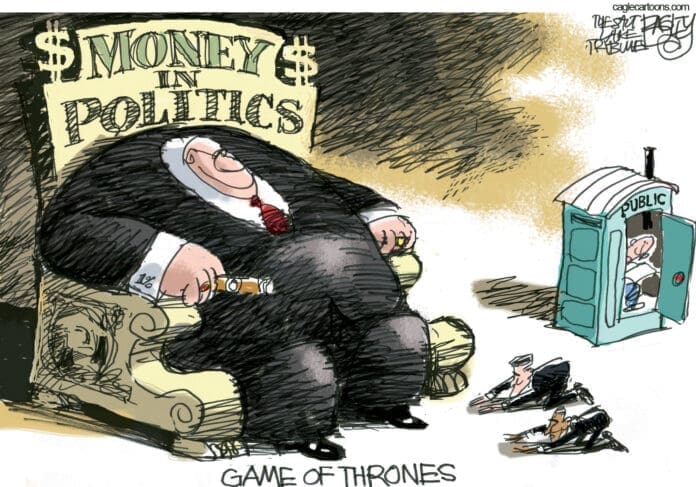
This is more than about Polston’s kid-gloves treatment by state Powers-That-Be. It is a vivid example of the corrosive effect of money in politics in the post-Citizens United era.
Years ago, when I covered the Texas Legislature, lawmakers distributed cigars, wrapped in plastic, bearing the message: “Money talks and bullshit walks.”
That’s no longer a punch line. It’s the cost of doing bidness.
Too cynical? Hardly. Ask yourself this: Would a random truck driver, store clerk or restaurant server be a candidate for a get-out-of-jail-free card? Not likely.
Polston had a huge advantage over the great unwashed. Her husband, Rod, not only was Stitt’s high school and college pal, but also is a well-known tax lawyer and a political donor.
Check out the recordings of the Polstons’ phone conversations while she was still incarcerated – as quoted in the grand jury report:
“Worst case scenario,” he told her, “you know what I’m going to do. If you’re not treated right, I … will wear some folks [out].”
Rod Polston went on to say he’d donated to a top Republican candidate for attorney general, former House Majority Floor Leader Jon Echols.
“I’ve got Jon Echols, too … and he’s going to be the next attorney general … so he’s got connections as well that he can help out if we need it.
“He’ll be a good one to have on, you know, if we need him. And, then, I’m probably gonna be getting back in the old political arena to help out as much as I can with whoever’s coming in next.”
Polston is lawyer. Someone schooled in the law. Presumably with at least a passing understanding of the potential legalconsequences of influence peddling.
The grand jury made clear Echols played no role in Polston’s case. And Echols ended up refunding $3,500 in Polston campaign contributions when the grand jury report was made public. Will that be enough to convince voters he could serve as an impartial, just-the-facts attorney general?
There’s also reason to believe legislators knew something fishy was up with Polston’s case. After her release, they overwhelmingly approved SB 137, making anyone convicted of a DUI that causes great bodily injury ineligible for ankle-monitoring.
It became law without the governor’s signature on May 5 – two days before the grand jury report was made public.
Oh, what a tangled web …
