


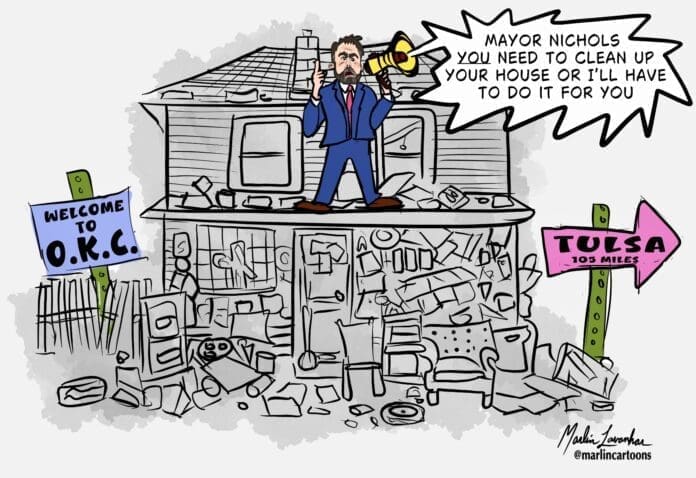
Let’s call this A Tale of Three Cities: Washington, DC, Oklahoma City and Tulsa.
In Washington, President Trump recently ordered the National Guard to assume law enforcement control of the nation’s capital, citing soaring crime rates.
In Oklahoma, Gov. Kevin Stitt’s administration unveiled plans to pull Highway Patrol troopers from the state’s two urban centers, redeploying them to rural areas where local law enforcement is stretched thin by increasing calls for help and changing traffic patterns.
Both decisions are preposterous, of course. The equivalent of political malpractice. How so?
So what are the 2,254 National Guard troops doing? According to CNN, some are “stationed” at metro stations, monuments and memorials, while “soldiers and airmen have also begun helping with ‘beautification projects,’ doing things like picking up trash, replanting grass, and spreading mulch.”
All of which costs taxpayers an estimated $1 million a day, when considering troops’ salaries, lodging, meals, fuel for vehicles, and laundry service.
What’s worse, though, is Trump inching ever so close to violating the Posse Comitatus Act which bars federal troops from civilian law enforcement unless explicitly authorized by Congress or the Constitution.
It’s a fundamental American principle that we are a civilian-run society, not militarily-ruled or -controlled. And yet Trump now threatens to send federal troops to other “blue” cities like Chicago and Baltimore.
All no doubt will be sorted out by the federal courts. But who knows how they’ll rule? Scary stuff.
In Oklahoma, thankfully, it appears Attorney General Gentner Drummond thrust a legal dagger into Stitt and Co.’s plans for troopers to cease patrolling interstates in Oklahoma City, Tulsa and suburbs like Edmond, Norman and Midwest City.
In a legally-binding opinion requested by OKC Sen. Mark Mann, Drummond insisted the OHP is “vested with primary law enforcement authority on our interstates, and that authority imposes a mandatory duty.”
Then he thrust a political dagger into the governor, with whom he often feuds: “I will not allow Gov. Stitt or OHP leadership to put Oklahoma citizens at risk by refusing to patrol our most densely populated areas.”
In response, a pissy governor announced he was ordering OHP troopers into Tulsa remove homeless encampments from state rights of way … in order to comply with a recently enacted state law. On Saturday night, I saw what appeared to be troopers conducting a similar cleanup in north OKC along the Kilpatrick Turnpike. [Stitt would never own up to such juvenile bowing up, of course.]
Courtesy reminder: Stitt is term-limited and cannot seek re-election next year; Drummond seeks to replace him. Meanwhile, Stitt acts for all the world like someone desperate to remain in public office – in the public limelight. So perhaps he thinks playing Trump 2.0 with OHP deployments somehow builds street cred with the MAGA crowd?
Quick question: If Stitt thinks the OHP’s budget is so tight it can’t afford to keep troopers in the metro centers, how can he justify diverting an already stretched force to do homeless encampment cleanup duty? Yes, they’re still in OKC and Tulsa but … that’s the best use of their presence?
Drummond’s legal opinion, by the way, drew bipartisan praise from Republicans like Sen. Paul Rosino and OKC Mayor David Holt and Democrats like Mann and Tulsa Mayor Monroe Nichols.
“Having troopers on our most heavily traveled highways is crucial for public safety,” Mann said. “This opinion clarifies that OHP resources should continue to be available for our metropolitan areas.”
In unveiling plans in early July to ruralize the Highway Patrol, Stitt’s hand-picked Public Safety Commissioner Tim Tipton seemed to be weighing the increasing rural demand for OHP help against the resources available to metropolitan law enforcement.
It would be incorrect, however, to assume urban police departments can afford to pick up the slack. The fact is, Oklahoma municipalities don’t have near the state’s options when it comes to generating revenue – limited mostly to sales, property and use taxes and assorted fees.
Left unsaid was another reality: If the Oklahoma Highway Patrol needs more resources, the state can afford it – with an estimated $5 billion sitting in various accounts.
All that’s needed is for the Legislature to decide how much – and from which fund to draw it. Because, after all, “The most fundamental function of government,” as Drummond put it, “is to provide public safety for its citizens.”